Gallery JJ Project 49
윤성진:2면 / 2시점
Yune Seongjin: 2 Faces / 2 Visions
2026. 02. 27 FRI - 04. 04 SAT
OPENING : 2026. 02. 27 FRI. 5 - 7 PM

전시글 Press Release
“조각의 ‘평면적 기억’, 회화의 ‘확장된 공간 기억’이 결합될 때, 미술 표현의 또 다른 가능성이 열린다.” ㅡ윤성진, 작가노트 2025
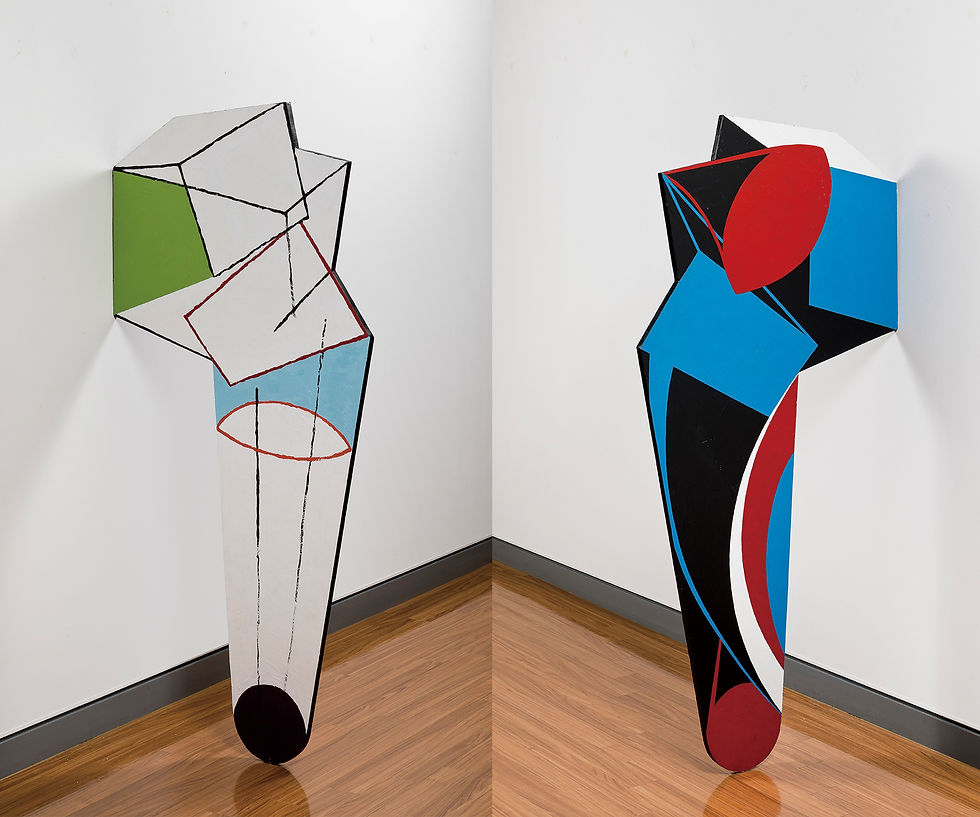
오늘날 조각은 소재나 표현 기법에 있어서 회화, 설치미술, 퍼포먼스, 영상 등과 혼성적 양식으로 나타나고 이러한 타 장르와의 결합을 통해 공간과 개념을 확장하고 있다. 갤러리JJ는 조각가 윤성진의 개인전 《윤성진: 2면 / 2시점》을 마련하였다. 윤성진은 회화와 조각을 넘어선 공간을 모색하고 동시대 조각의 새로운 경험을 탐색한다. 작가는 전통 조각의 물성과 양감을 최소화하여 회화적 평면을 지향하는 역설적인 접근방식으로, 회화적 평면의 양면을 가지는 추상적 오브제인 ‘2면 조각(2-face sculpture)’을 제시한다. 그것은 조각 구조에 회화적 경험을 결합하는 것으로 나타난다. 이번 전시는 작가가 파리에서의 오랜 생활을 마치고 서울로 돌아온 이후 지난 4년간의 작업들을 모아 최초로 선보이는 자리로, <접힌 사각형> 등 신작을 비롯하여 그의 작업의 대표적인 ‘2면 조각’들을 소개한다. 전시는 20여점의 공간에 세우는 스탠딩 작업과 벽면을 이용하는 벽 작업으로 구성된다. 이번 전시는 그 동안 그가 사유하고 구축해온 특유의 조형 방식과 관람객의 시지각적 경험을 기반으로 하는 작품세계의 독자성을 조명한다.
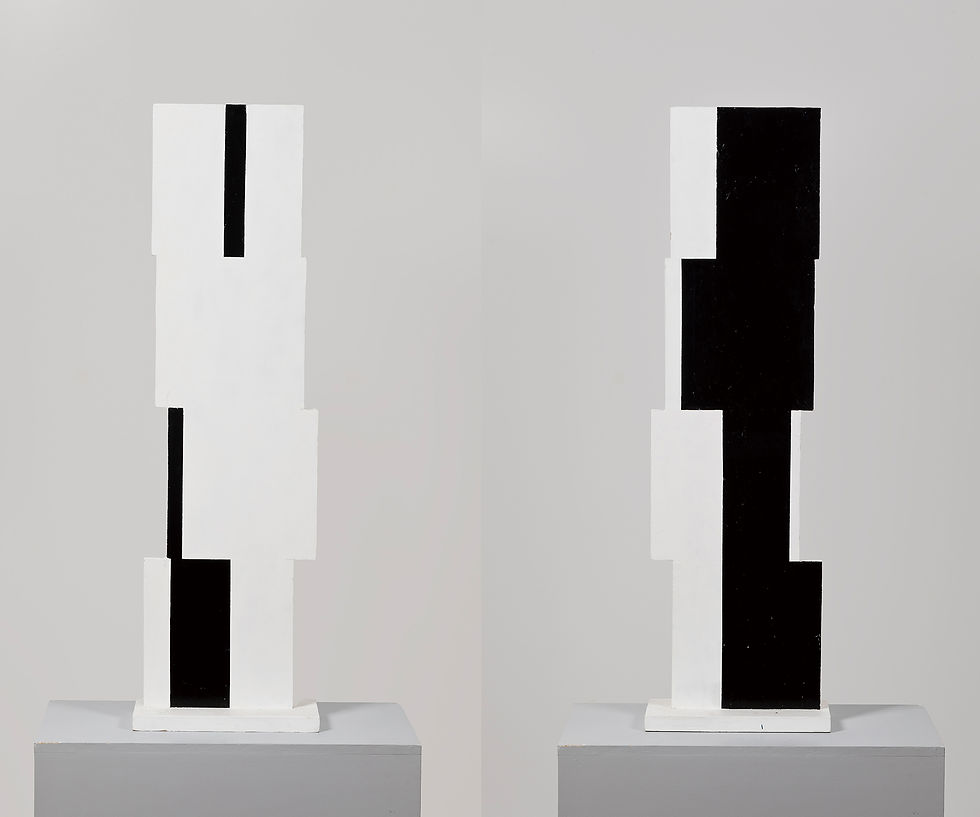
윤성진의 추상조각은 기하학적 조형요소 및 서예에서 비롯된 원리와 조형적 감각을 바탕으로, 회화의 평면성과 조각의 구조가 만나는 지점을 탐구하며 현대조각의 경계를 확장해왔다. 회화와 표현의 경계가 맞물리는 조형 구조를 가진 그의 작업은 조각이 점유해 온 물리적 공간을 넘어 평면 내부에서 발생하는 공간적 긴장과 감각의 층위를 섬세하게 드러냄으로써 평면과 입체에 대한 질문을 던진다. 작가가 ‘회화적 조각’ 혹은 ‘2면 조각’이라 명명하는 작업은 기하학적 추상 구조를 기반으로 하며, 회화와 조각, 설치라는 장르의 경계를 오간다. 하나의 얇은 판 위에 서로 다른 두 회화적 면을 병치하는 방식은 평면과 입체 사이의 긴장을 형성하며, 관람자의 이동과 시선의 변화 속에서 작품이 점진적으로 완성되도록 유도한다. 이로써 작업은 앞과 뒤, 내부와 외부라는 이분법적 구분을 넘어, 두 면 사이에서 분위기가 교차하는 또 다른 감각적 공간을 생성한다.
돌이켜보면, 과거에도 예술 형식들은 서로 완전히 닫혀지지 않았다. 오랜 서양 조각의 역사에서 조각은 건축, 회화와 분리되지 않고 상호 작용했으며, 르네상스 이후 이들은 독립하여 자율적 형식을 갖추게 되었고 시간이 지남에 따라 형식 간의 경쟁이 스스로에게 집중하고 강력한 방식임을 입증하는 식으로 진전되었을 뿐이다. 현대미술에 이르러 새로운 소재로 질량을 최소화하고 내외부를 연결하여 전통적 조각의 틀에서 벗어나고자 했던 조각가 나움 가보(Naum Gabo), 사진이라는 매체를 조각으로 끌어들여 조각의 커다란 화두인 평면과 입체에 대한 질문을 던지는 권오상 작가 등 조각의 정체성은 끊임없이 도전 받아왔다.
지난 1990년대 초 작가는 과학의 발달로 인한 가치관의 변화와 혼돈의 시대를 표현하고 자연파괴와 인간성의 피폐함을 고발하는 등 표현성이 짙은 작업으로 잘 알려져 있다. 은빛 알루미늄판을 자르고 조합하는 등 1970년대 한국미술의 물성 탐구의 계보를 잇는 작업을 하였고, 그의 작업들은 국립현대미술관을 비롯하여 시립미술관 등 국내외 주요기관에 소장되어 있다. 주관적인 감성과 물성을 중시하는 표현주의적 작업은 어느덧 변화하여 현재의 균형과 이성 중심의 기하학적 추상 형태에 이르게 되었고, 이에 대한 궁금증을 불러일으킨다. 그것은 20여년 가까운 파리 생활에서 몸에 배인 문화적 분위기와 십자가 형태의 조형작업과의 연관관계, 러시아 구성주의를 비롯한 20세기 초 미술사를 숙고하여 차용하게 된 점, 그리고 무엇보다 작가 자신의 깊숙한 내부로부터 대면한 서예의 조형성에 대한 기억에서 그 이유를 찾을 수 있을 것 같다.
선, 면, 공간
전시장에 벽과 바닥에 설치된 기하학적 추상 오브제들은 선과 면이라는 조형의 기본 요소들이 평면의 내부는 물론 조각의 구조적 형태로서 연속적으로 펼쳐진다. 절제된 단순한 색채 사용은 형태의 구조적 특징을 강화한다. 작품들은 내부에 뚫린 구멍으로 인해 작품의 내부와 외부의 구별 없이 공간이 연결된 형태이거나 혹은 대부분이 서로 유기적으로 연결된 사각형이나 원들이 반복하고 증식하며 공간 속으로 확장되는 듯하다. 작품은 개별요소보다 전체의 구조적 맥락 속에서 파악된다.
윤성진의 조형 세계를 내부적으로 들여다보면, 동양 전통의 수묵과 서예에서 비롯된 획의 조형적 감각과 선(linear)적 행위를 공간으로 끌어내며, 구조주의적 사고와 함께 현대미술사의 차용과 변용으로 과거 역사를 참조한다. 작가는 조각에서 ‘매스를 축소하려’고 지속적으로 고민해왔으며, 서예에서의 필묵과 여백이 만들어내는 내외부공간의 긴장 관계에 주목하여 조각적 구조로 확장한다. 즉, 획의 역동성은 평면에 머무르지 않고 그것이 가로지르는 공간을 점유하며, 작가는 이러한 붓과 종이 사이에서 발생하는 긴장감과 궤적을 실제 공간으로 가져와 공간 자체를 하나의 조각적 현실로 만든다.
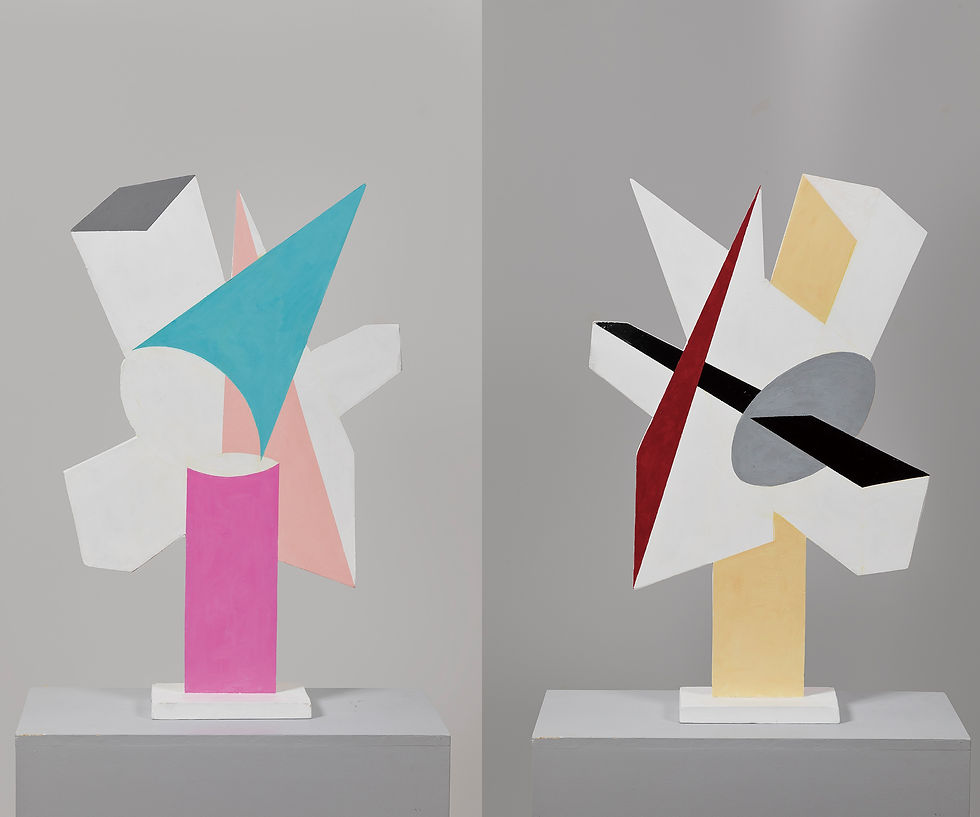
그것은 서양예술론에서, 조형예술의 근간을 이루며 조각과 회화, 건축을 아우르는 선묘(dessin)의 방식으로 곧 작업은 아이디어와 조형요소들을 공간으로 끌어당기는 ‘공간 드로잉’으로서 공간에서 확장 가능성을 내재하는 ‘열림’의 미학을 보여준다. 좀더 논리를 이어가면, 르네상스 시기 뵐플린(Heinrich Wölfflin)의 구분에 의하면 조각은 곧 선(linear)적인 것이었고, 드로잉의 의미로서의 ‘디세뇨(disegno)’가 강조했던 형이상학적 사고는 20세기초 조형구조를 이성과 질서로 조직하려는 러시아 구성주의 작가들에 의해 기하학적 추상 체계로 확장되었으며 이들은 다시 조각과 디자인, 건축을 통합하려 했다. 실지로 바우하우스를 시작으로 디자인은 기하학적 추상언어를 기능성과 시각 체계로 발전시켰다. 윤성진의 추상조각은 이러한 원리 위에서 작동하는 것으로 보인다. 작업 가운데 <말레비치에 대한 오마주>가 보인다. 전통과 현대를 아우르는 그의 작업 여정은 조화로운 정신의 조형적 원형, 보편성을 향한 과거 유토피아적 꿈의 또 다른 지평을 여는 일은 아닐까?
조각의 회화적 경험
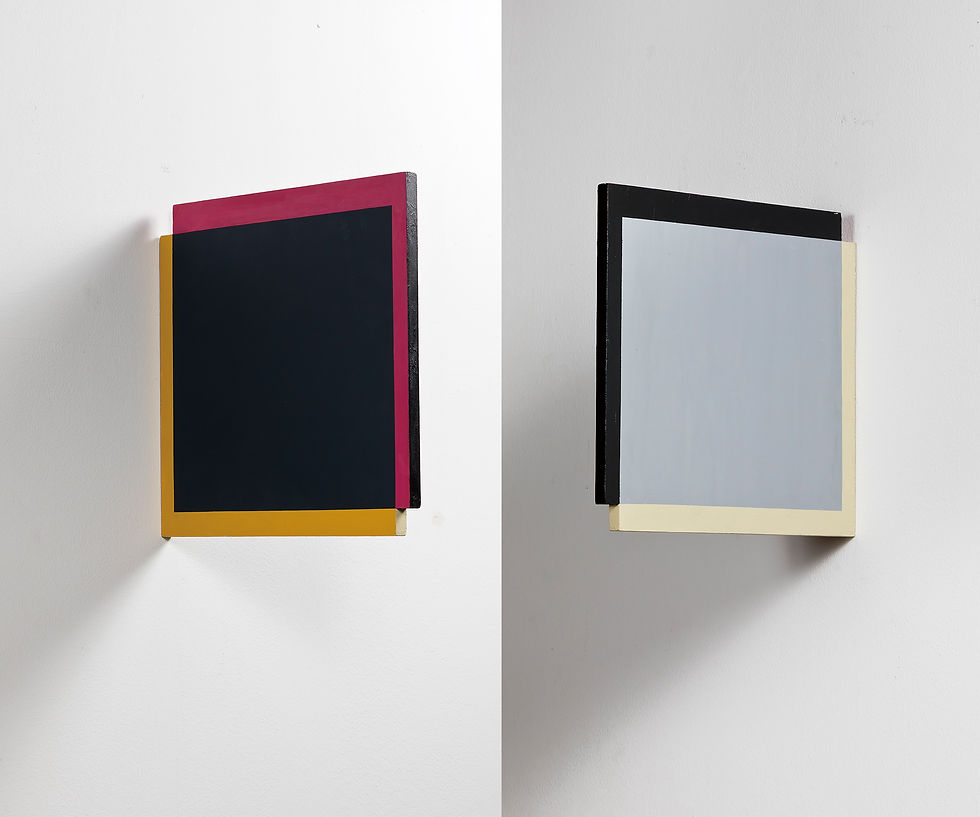
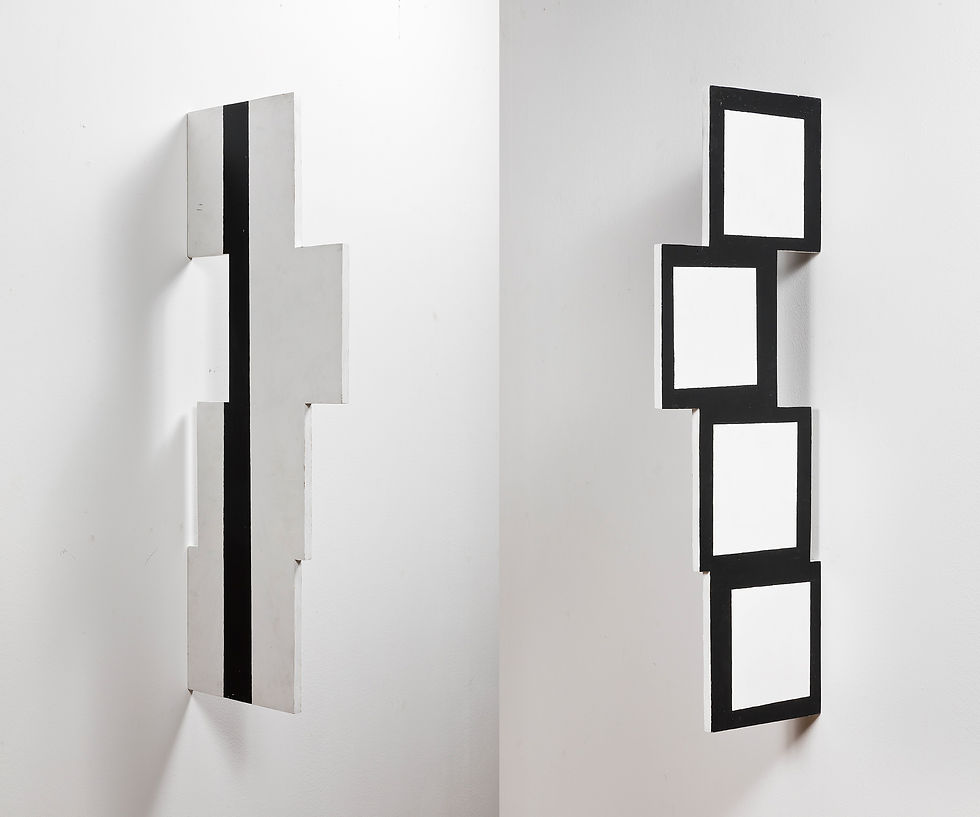
전시의 작품들은 마치 바닥에 우뚝 서있는 회화, 벽에 모서리를 대고 직각으로 붙은 회화처럼 보이기도 한다. <식물로부터>, <달>, <여인들>처럼 재현적이고 서정적인 제목이 있는가 하며 <접힌 사각형>, <상자들>과 같이 시각적 착시를 유도하기도 한다. 작품들은 그 구조가 마치 하드엣지의 변형된 캔버스나 혹은 회화 지지체의 지표적 기호처럼 그리드를 이루기도 한다. 생각해보면, 평면을 연장하면 입체가 되지 않는가. 재료로 사용한 ‘코어합판’은 변형이 없고 가벼워서 물체의 질량을 최소화하면서 입체의 골격이자 그 표면을 회화의 지지체로 내주고 있다. 작가는 잔상이나 그림자와 같은 비물질적 요소를 생각하며 조각의 물성을 최대한 무화시킬 수 있는 방법으로 이 소재를 선택했다고 말한다. 이렇게 그가 조각의 물질성에 저항하면서 회화를 끌어들이며 얻는 것은 무엇일까? 그것은 동어반복일 수도 있지만 여러 면에서 생각해 볼 수가 있다. 비가시적인 또 다른 리얼리티의 공간을 찾는 조형적 실험, 회화의 프레임 바깥 공간을 드러내어 이차원 이미지 너머로 회화를 확장하거나 동시에 조각의 정체성에 대한 질문, 조각의 회화적 경험의 도입 등···.
전시 제목이자 작품 제목인 ‘2면 2시점’에서 알 수 있듯이, 그의 작업은 회화적 시점을 조각 내에 도입함으로써, 다면적 시점으로 분산되는 전통적 조각의 불확실한 경험에서 벗어나 회화가 지닌 정면성의 단일하고 지속적 시점의 명료함을 조각 구조 안에서 구현하고 있다. 과거에 회화는 원근법을 통해 3차원의 자연을 평면에 재현하면서 자연에 대한 지성의 우월함을 주장했고 3차원 입체로서의 조각은 재료의 물질성과 공간 점유, 연극성의 경험을 기반으로 하여 서로 경쟁적 관계를 맺기도 했다. 윤성진은 이러한 두 매체의 긴장 관계를 조형적으로 결합하며, 회화의 평면성과 조각의 공간성이 만나는 접점을 탐구한다.
그 결과, 조각의 표면이자 회화 평면은 반복되는 프레임의 경계를 넘어 실제 공간에서의 조각적 형태까지 회화로 끌어들임으로써, 조각이 오브제성을 넘어 회화적 인식 속에서 새로운 감각적 깊이를 얻게 되었다. 틀에 의해 전적으로 회화의 내부에 한정되었던 관조적 영역은 물리적 공간 속에서 관람자의 신체 이동과 시간적 경험 속에 놓인다. 이처럼 윤성진의 작업은 회화적 시점을 도입하여 조각적 구조에 회화의 경험을 유도하면서, 회화의 평면성과 조각의 입체성이라는 형식주의의 이분법적 구분을 가뿐히 넘어선다.
글 | 강주연, 갤러리JJ 디렉터
"When sculpture's planar memory merges with painting's expanded spatial recall, new possibilities for artistic expression emerge." —Yune Seongjin, Artist Note, 2025
Sculpture today increasingly appears in hybrid forms, merging with painting, installation, performance, and video in both material and technique, expanding spatial and conceptual realm. Gallery JJ is pleased to present Yune Seongjin: 2 Faces, 2 Visions, a solo exhibition by sculptor Yune Seongjin whose practice probes territory beyond the inherited division between painting and sculpture, proposing new experiences of contemporary sculpture. By minimizing the mass and volumetric weight traditionally associated with sculpture while pursuing pictorial flatness, he presents what he terms 2-face sculpture—abstract objects with two painted surfaces that blend painterly experience within sculptural structure. This exhibition marks the first comprehensive showing of four years of work since his return to Seoul after an extended period in Paris, featuring new works including Folded Square along with some twenty freestanding and wall pieces that foreground his distinct plastic language grounded in its visual experience and the viewer’s shifting perceptual engagement.
Yune’s abstract sculpture, rooted in geometric form and principles drawn from calligraphy, examines where painting’s flatness meets sculptural structure. His work operates in this liminal zone, displacing sculpture’s claim to physical space toward tensions generated within the plane itself, reopening questions of surface and volume. What he calls painterly sculpture or 2-face sculpture is based on geometric abstraction and moves between the boundaries of painting, sculpture, and installation. By juxtaposing two different pictorial surfaces on a single thin panel, he initiates tension between plane and volume, leading the work to complete itself gradually by the viewer's bodily movement and shifting gaze. The work thus exceeds binary divisions—front and back, interior and exterior—producing another sensory space where atmospheres cross between the two faces.
Historically, art forms were never entirely sealed from one another. Throughout Western art history, sculpture existed subsumed within architecture and painting rather than as an independent medium. Only after the Renaissance did these forms crystallize into autonomous genres, and over time, their competition intensified towards self-definition. Sculpture’s identity has repeatedly been challenged—from Naum Gabo, who sought to escape traditional frameworks by reducing mass with new materials and connecting interior and exterior, to Kwon Osang, who brings photography into sculpture to pose questions about flatness and three-dimensionality.
In the early 1990s, Yune was first recognized for highly expressive work articulating shifting values and social upheaval driven by scientific advancement, and denouncing the destruction of environment and humanity. He worked in the lineage of 1970s material exploration in Korea, cutting and assembling silver aluminum panels, and these are now held in major collections in Korea and abroad, including the National Museum of Modern and Contemporary Art. His emphasis on subjective expression and materiality eventually shifted toward geometric abstraction marked by balance and rational order. This turn traces back to the cultural atmosphere embodied in his two decades in Paris, to his early cruciform works, to sustained engagement with early twentieth-century art history including Russian Constructivism, and above all to his memory of calligraphy's plasticity.
Line, Plane, Space
The geometric abstract objects present fundamental formal elements—line and plane—as both internal space and external structural presence. His restrained palette reinforces their compositional clarity. Some are perforated to efface interior and exterior boundaries, while others multiply through repeated squares and circles, expanding into surrounding space. Each work is understood within its overall context rather than through individual elements.
Yune pulls the formal sensibility of brushstrokes and linear actions from ink wash painting and calligraphy into space, and references modern art history through appropriation, transformation and structuralist thinking. He has sought to reduce mass in sculpture, focusing on the tensional relationship between interior and exterior space created by ink and void in calligraphy, expanding this into volumetric construct. The dynamism of brushstrokes doesn't remain on the surface but occupies the space they traverse; Yune brings such tension and trajectory between brush and paper into actual space, making space itself a sculptural reality.
This recalls the Western tradition of dessin—drawing as the foundation underlying sculpture, painting, and architecture. In this sense, Yune’s practice approaches as a form of spatial drawing, revealing an aesthetics of openness in which space remains expandable by elements pulled into it. Moreover, Heinrich Wölfflin’s distinction between linear and painterly modes positions sculpture as fundamentally linear. The metaphysical emphasis in disegno resurfaces in the early twentieth century, when Russian Constructivist reorganized form through reason and order, aiming to merge sculpture, design, and architecture into a consolidated language. From the Bauhaus onward, design evolved geometric abstraction into functional visual system. Yune’s abstract work operates in this continuum. His Homage to Kasimir Malevich marks this historical consciousness. His artistic practice bridging tradition and modernity suggests an attempt to locate a plastic archetype of unison spirit, and perhaps recalling the utopian dream once imagined through abstraction and universality.
The Painterly Experience of Sculpture
At first glance, works in the exhibition may appear like paintings standing upright on the floor, or attached at angles to walls. Some carry representational, lyrical titles such as From Plants, The Moon, and Female, while others like Folded Square and Boxes induce visual illusion. Some resemble shaped canvases or grided supports for painting surface. Extending a plane creates volume. Yune constructs pieces from core plywood, a lightweight, stable material that can minimize mass while providing skeletal makeup and support for picture plane. The artist states he chose this material thinking of immaterial elements like afterimages and shadows, seeking to dissolve sculptural materiality as much as possible. What would he gain by resisting materiality and incorporating painterly means? The answer unfolds along several axes: formal experiment pursuing invisible reality; revealing space beyond painting's frame to expand the medium past two-dimensional image; inquiry into sculpture’s identity itself; and hinting at a painterly encounter with sculpture.
As the exhibition title suggests, by introducing pictorial perspective into sculpture, his work departs from the uncertain, discrete experience of traditional sculpture scattered across multiple viewpoints. Instead, it seeks to realize within sculptural structure the clarity of painting's frontal, singular, sustained gaze. Historically, painting asserted intellectual superiority over nature by representing three-dimensional space on a flat surface via perspective, while sculpture also claimed competitive edge through material presence, spatial occupation, and theatricality. Yune compresses this rivalry into his own vocabulary, working at the juncture where painting's flatness meets sculpture's spatiality.
What emerges is a surface simultaneously sculptural and pictorial—the picture plane expands beyond the repeated boundary of the frame and extends into real space as sculptural form, allowing them to transcend objecthood and gain new sensory depth within pictorial perception. The contemplative field once confined within canvas now exists in physical space, subject to the viewer's bodily movement and durational encounter. By introducing pictorial perspective into sculptural structure, Yune's work induces a painterly experience that transcends the division between painting's flatness and sculpture's volume.
Text | Juyeon Kang, GalleryJJ Director
WORKS ON VIEW











BIOGRAPHY
윤 성 진 (b.1952)
조각가 윤성진(b.1952)은 서울대학교 조소과와 동대학원을 졸업한 후 1985년 첫 개인전을 시작으로 수많은 전시에 참여하면서 독자적인 조형언어를 구축해왔다. 1990년대 초에 그는 과학기술 발전으로 인한 가치관의 혼란과 환경 파괴를 표현한 표현주의적 작업으로 주목받았다. 이후 1995년부터 20여년간의 파리 생활 이후 그의 작업은 이전의 감성과 물성을 강조한 표현주의적 작업에서 현재의 균형과 이성 중심의 기하학적 추상조각으로 전환되었다. 작품은 국립현대미술관을 비롯해 국내외 주요 기관에 소장되어 있다. 윤성진은 기하학적 조형언어를 바탕으로 회화와 조각을 넘어선 공간을 모색하고 동시대 조각의 새로운 경험을 탐색한다. 그의 추상 오브제인 ‘2면 조각’은 ‘조각적 구조에 회화의 경험을 유도’하면서 조각과 회화, 설치라는 장르의 경계를 오가고 ‘입체와 평면에 대한 질문’을 던진다.
현 호서대학교 특임교수
1981 서울대학교 대학원 졸업
1976 서울대학교 미술대학 조소과 졸업
주요 개인전 (1985~)
2026 윤성진: 2면 / 2시점, 갤러리JJ, 서울
2018 아트원갤러리, 서울
2015 아트스페이스호서, 서울
2010 갤러리뤼멘, 파리, 프랑스
2004 마로니에미술관 문예진흥원, 서울
1999 한국문화원, 파리, 프랑스
1994 금산갤러리, 서울
이십일세기화랑, 서울
1991 이콘갤러리, 서울
1989 무라마츠화랑, 도쿄, 일본
1988 동아미술제: ’78-’86 대상, 미술상수상작가초대전, 국립현대미술관, 과천
1985 그로리치화랑, 서울
주요 그룹전 (1985~)
2022-25 서울조각회전, 낙우조각회전, 모란미술관, 남양주
2020 국립현대미술관 소장작품전, 전북도립미술관, 전북
2013 피카소에서 제프쿤스까지, 예술의전당, 서울
2008 La Croix, Galerie Lumen, 파리, 프랑스
2003 중국과 한국의 현대조각, CASO, 오사카, 일본
2002 Tradition and Innovation2, 에센, 독일&제네바, 스위스
2000 Par Lui, Pour Lui, Clpoitre des Billettes, 파리, 프랑스
1999 Yune, Seong Jin·Park, Sang Sook, Centre Culturelle Coreen, 파리, 프랑스
FIAC, Gallerie Hyundai, 파리, 프랑스
Dialogue avec la Nature, Festival International de Geographie, 프랑스
1998 Artist Coreens; Espace Chateauneuf, 투르, 프랑스
L'art contemporain Coreen, Ambassade de Coree, 파리, 프랑스
1995 1995 중앙비엔날레, 호암미술관, 용인
1994 보이지 않는 차원, 최갤러리, 서울
한국현대미술의 흐름, 인사갤러리, 서울
1993 십이월전-그후 십년展(전), 덕원미술관, 서울
1992 '92 현대미술특별전: 양화, 조각, 국립현대미술관, 과천
'92 서울-삿보로전, 서울시립미술관, 서울
한-중 예술연합전, 예술의전당, 서울
'92 한국미술의 상황과 진단전, 공평아트센타, 서울
1991 이강소·오수환·이영학·윤성진, 갤러리예향, 서울
1990 '90 현대미술초대전: 양화, 조각, 국립현대미술관, 과천
1989 한국현대미술-80년대의 정황, 동숭아트센터, 서울
1987 한국조각의 오늘, 야외조각전, 호반광장, 춘천
1985 서울 90전, 관훈미술관, 서울
수상
'86 동아미술제 대상, 동아일보, 서울(1986)
작품 소장처
국립현대미술관, 서울시립미술관, 전쟁기념관, 오산고등학교, 양재시민공원, 토탈야외조각공원, 제주조각공원, 한국은행(강남지점), 인촌기념관, 파라다이스호텔(부산), 그라스타워(서울), L.G마트, 안원산업사옥, 메이필드호텔, CTS방송국, Corner Stone 교회(로스엔젤리스, 미국), 광진구민회관, 한국라브리(양양), 중앙감리교회(양양), 예수님의 마을(마르세유, 프랑스), 호서대학교
Yune Seongjin (b.1952)
Sculptor Yune Seongjin studied sculpture at Seoul National University (BFA and MFA), and held his first solo exhibition in 1985. Since then, he has developed a distinct formal language through several exhibitions in Korea and abroad. Over his two-decade period in Paris, his work has shifted toward geometric abstraction defined by balance and order The works are held in major collections including the National Museum of Modern and Contemporary Art, Korea. Working within a geometric vocabulary, Yune explores territory beyond the division between painting and sculpture, proposing new experiences of contemporary sculpture. His two-face sculpture introduces painterly experience into sculptural structure, moving between sculpture, painting, and installation while posing questions of plane and volume.
Current Specialized Professor, Hoseo University
1981 M.F.A Art Education, Graduate School of Education, Seoul National University
1976 B.F.A Sculpture, College of Fine Arts, Seoul National University
Solo Exhibitions
2018 By Him and For Him, Seocho Church Art One Gallery, Seoul
2015 The Cross, Sculptor Yune Seong-Jin Solo Exhibition, Art space Hoseo, Seoul
2010 Galerie Lumen, Paris, France
2004 Maronie Art Center Culture and Arts Promotion Board, Seoul
1999 Korean Cultural Center, Paris, France
1994 Keumsan Gallery, Seoul
21st Century Gallery, Seoul
1991 Icon Gallery, Seoul
1989 Muramatsu Gallery, Tokyo, Japan
1988 1988 Dong-A Art Festival, MMCA, Gwacheon
1985 Gallery Growrich, Seoul
Selected Group Exhibitions (1985~)
2022-25 Seoul Sculptors Society Exhibition, Moran Museum of Art, Namyangju
2020 MMCA Collection Exhibition, Jeonbuk Museum of Art, Jeonbuk
2013 From Picasso to Jeff Koons, Seoul Arts Center, Seoul
2008 La Croix, Galerie Lumen, Paris, France
2003 Contemporary Sculpture of China and Korea, CASO, Osaka, Japan
2002 Tradition and Innovation 2, Essen, Germany&Geneva, Switzerland
2000 Par Lui, Pour Lui, Cloître des Billettes, Paris, France
1999 Yune, Seong Jin·Park, Sang Sook, Centre Culturelle Coreen, Paris, France
FIAC, Galerie Hyundai, Paris, France
Dialogue avec la Nature, Festivl Int'l de Geographie, St. Die des Vosges, France
1998 Artists Coreens, Espace Chateauneuf, Tour, France
L’Art Contemporain Coreen, Ambassade de Coree, Paris, France
1995 JoongAng Biennale, Ho-Am Art Museum, Gyeonggi
1994 Invisible Dimension, Choi Gallery, Seoul
The Flow of Korean Contemporary Art, Insa Gallery, Seoul
1993 Group December-10 years later, Deokwon Gallery, Seoul
1992 ‘92 Special Exhibition of Contemporary Art: Painting & Sculpture, MMCA, Gwacheon
‘92 Seoul-Sapporo Exhibition, Seoul Museum of Art, Seoul
Korea–China Art Association Exhibition, Seoul Arts Center, Seoul
’92 Situatuion and Diagnosis of Korean Art, Gongpyeong Art Center, Seoul
1991 Lee, Kang So·Oh, Su Whan·Lee, Young Hak·Yune, Seong Jin, Yehyang Gallery, Seoul
1990 90’ Contemporary Art Invitational Exhibition: Painting & Sculpture, MMCA, Gwacheon
1989 Korean Contemporary Art: The Context of the 1980s, Dongsung Art Center, Seoul
1987 Korean Sculpture Today, Outdoor Sculpture Exhibition, Hoban Plaza, Chuncheon
1985 Seoul ’90 Exhibition, Gwanhun Museum of Art, Seoul
Awards
Grand Prize, Dong-A Art Festival , Dong-A Ilbo, Seoul(1986)
Public Collections & Installations
National Museum of Modern and Contemporary Art of Korea, Seoul Museum of Art, The War Memorial of Korea, Osan High School, Yangjae Citizens' Forest, Total Open-air Museum of Art, Jeju Sculpture Park, The Bank of Korea(Gangnam Branch), Inchon Memorial Hall, Paradise Hotel(Busan), Glass Tower(Seoul), L.G Mart, Anwon Building(Anwon Industries Headquarters), Mayfield Hotel(Seoul), CTS TV(Seoul), Corner Stone Church(Los Angeles, USA), Kwangjin Culture Center(Seoul), L’Abri Fellowship Korea(Yangyang), Central Methodist Church(Yangyang), Le Village de Jésus(Marseille-en-Beauvaisis, France), Hoseo University Church(Asan)